


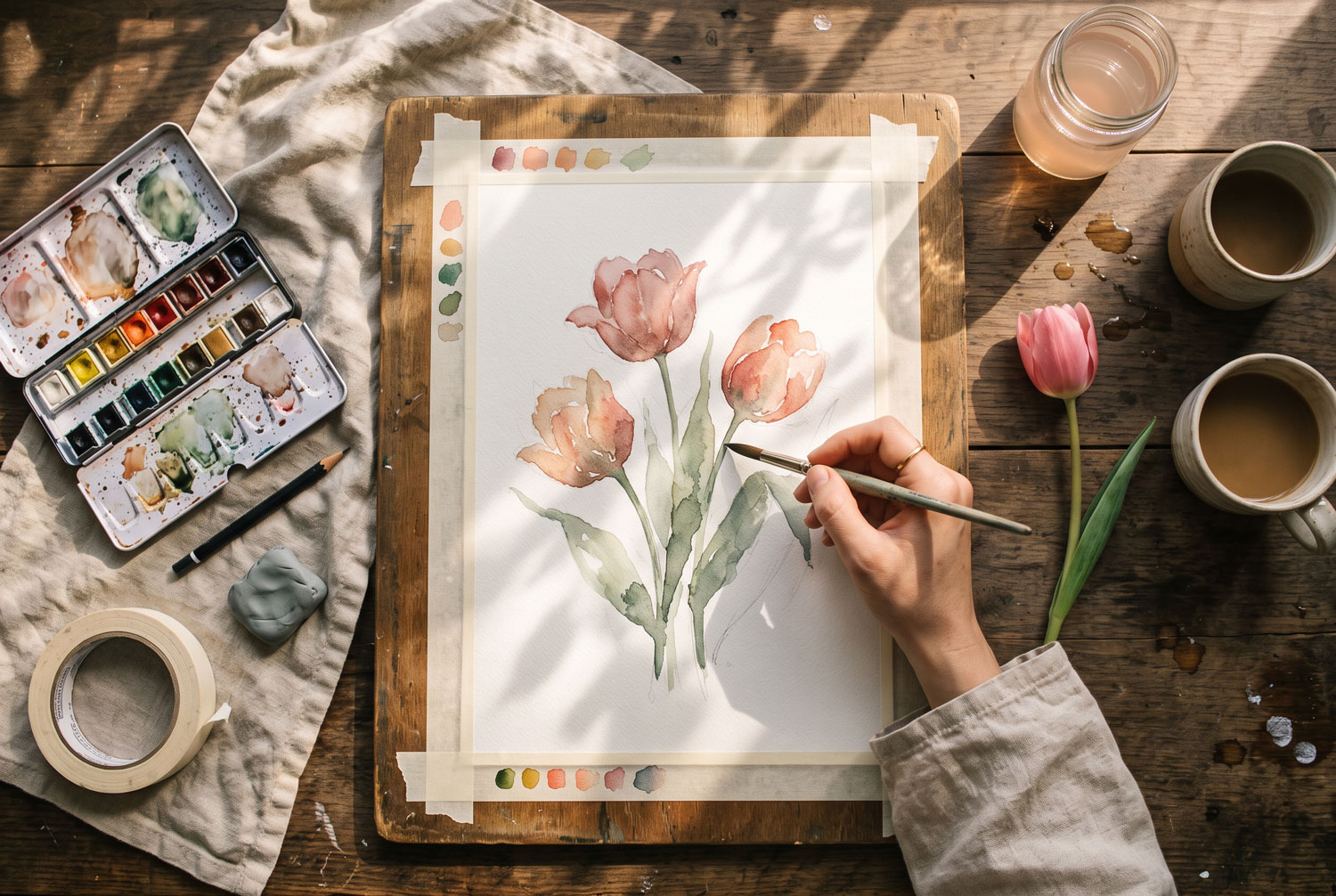
28 Oct The Only 6 Supplies You Need to Start Watercolor
Walk into any art store and you’ll find hundreds of paints, brushes and papers, so it’s easy to think you need a full cart before you can paint anything. The good news? The only watercolor supplies for beginners you really need are 6 simple items, and they’re enough to finish your very first painting.
If you’ve been wondering “what do I need to start watercolor?”, this guide walks through each item:
- why you need it
- what to look for
- what I use myself
- and a budget-friendly
At the end there’s a list of things you can safely skip, so you don’t waste money.
Best for: complete beginners · Reading time: about 7 minutes
Quick List: The 6 Watercolor Supplies for Beginners
| Supply | What to choose | What I use | Also good |
|---|---|---|---|
| 1. Paint | A student-grade pan set, 12–24 colors | HIMI | Winsor & Newton Cotman |
| 2. Brushes | 2–3 synthetic round brushes (large, medium, small) | Mostly a size 8 round | A brush set with sizes 10 and 16 for bigger areas |
| 3. Paper | 300gsm (140lb) cold press watercolor paper | BAOHONG Academy, 100% cotton | Canson XL 300gsm (cellulose) |
| 4. Pencil | An HB pencil, used with a light hand | A regular HB pencil | An H or 2H pencil for extra-light lines |
| 5. Eraser | A soft eraser that won't scuff the paper | A soft eraser | A kneaded eraser |
| 6. Tape | Any tape that peels off cleanly | Whatever tape I have on hand | Low-tack artist or painter's tape |
1. Paint: Start with a Pan Set
Why you need it: paint is the obvious first item on any list of watercolor supplies for beginners, but choosing the right type makes your first few weeks much easier.
What to look for: a student-grade pan set with about 12–24 colors. Pans activate with a wet brush, stay tidy, travel well, and you won’t waste paint by squeezing too much out of a tube.
Student or artist grade? Student paints cost less because they contain less pigment, but trusted brands still give you lovely, easy-to-use color. You don’t need artist-grade paint yet. Once you’re comfortable, replace your most-used colors with artist-grade ones, one at a time.
What I use: my HIMI set: bright colors that reactivate quickly with water, at a price that lets you practice freely.
Also great: Winsor & Newton Cotman, widely seen as the benchmark student-grade line for beginners.
Upgrade later: Daniel Smith Extra Fine Essentials (six artist-grade tubes) or Winsor & Newton Professional.
2. Brushes: You Only Need 2–3 Round Brushes
Why you need it: your brush decides how well you control water, and water control is the real secret of watercolor.
What to look for: round synthetic brushes. They cost far less than natural hair and still hold plenty of water. Two or three are enough: one large (size 12–16) for base washes, one medium (size 8–10) for most of the painting and one small (size 2–4) for details.
Quick brush test: when it’s wet, a good brush comes to a sharp point on its own and springs back after you press it down.
What I use: a watercolor brush set, though I really only reach for two: a size 16 for quick base layers and a size 10 for smaller areas.
3. Paper: The One Supply Worth Investing In
Why you need it: if you can spend a little more on just one item, make it paper. Thin paper buckles, paint pools into puddles and dries patchy, and many beginners think they’re bad at painting when the paper is really to blame.
What to look for: true watercolor paper (not drawing or mixed-media paper) at 300gsm (140lb) with a cold press surface. It’s the most popular weight, thick enough for several layers without stretching the paper first, which is why it tops every list of watercolor supplies for beginners.
Cotton or cellulose? Cellulose (wood pulp) paper is affordable and fine for practice. 100% cotton paper absorbs color more evenly, blends more softly and forgives mistakes, so beginners get nicer results faster. A smart approach: practice on budget paper and save a few cotton sheets for paintings you want to keep.
What I use: BAOHONG Academy paper, cold press, 300gsm, 100% cotton. Cold press isn’t as bumpy as rough paper, yet it keeps more texture than hot press. It’s cotton paper at a friendly price.
Budget pick: Canson XL Watercolor 300gsm (cellulose), one of the most popular practice papers in the US.
4. Pencil: The Lighter, the Better
Why you need it: to sketch a few guidelines before you paint.
What to look for: a hard H or 2H pencil. Harder graphite makes lighter lines that are less likely to show through transparent paint or dull your colors. Soft pencils (B, 2B and up) make darker lines that smudge and can make colors look dirty. An HB from your drawer works too; just keep a very light hand.
Good to know: once dry paint covers a pencil line, the line is sealed in and won’t erase. Sketch lightly, and lighten your lines before you paint.
5. Eraser: A Kneaded Eraser Protects Your Paper
Why you need it: to lighten pencil lines before you start painting.
What to look for: a kneaded eraser, the soft, putty-like kind. Press and lift instead of rubbing, and it picks up graphite without scuffing the paper.
Why not a regular eraser? Rubbing hard roughs up the paper surface. When you paint, color settles into those rough spots and shows up darker than the area around them.
Alternative: a soft white vinyl eraser, used gently.
6. Tape: A Small Supply That Saves Your Painting
Why you need it: taping all four edges to a table or board keeps your paper flat while it’s wet, with far less buckling. And when you peel it off, you get a crisp white border that looks ready to frame.
What to look for: low-tack artist tape or a low-tack painter’s tape. Avoid regular household masking tape, which grips too hard and can tear the paper surface when you remove it.
How to peel it without tearing: Only remove it once the painting is completely dry, pulling slowly at a low angle, away from the painting.
Things You Already Have at Home
Beyond these six watercolor supplies for beginners, you only need a few household items:
- Two jars of water: one for rinsing your brush, one with clean water for mixing.
- Paper towels: to blot extra water from your brush, and to act as watercolor’s “eraser” when you need to lift paint.
- A white ceramic plate: a perfect mixing palette if the lid of your paint set is too small.
What You Can Skip for Now
These look tempting next to the real watercolor supplies for beginners on the shelf, but you don’t need them yet:
- 15–20 brush sets: you’ll use two or three, and the rest will sit in the box.
Sets with 48+ colors: mixing from fewer colors helps you learn faster.
Expensive natural-hair brushes: today’s synthetic brushes are more than good enough for beginners.
- Extra-heavy 640gsm (300lb) paper: wonderful, but 300gsm is plenty when you’re starting out.
- Masking fluid, an easel, watercolor pencils: save them for when you feel comfortable.
Paint your first picture with me today.
Your First Painting with Your New Supplies
Easiest, just 5 minutes: Easy Watercolor Practice Playlist. All you need is 4 colors, 2 brushes and a postcard-size sheet, and there’s no sketching required.
Still unsure which watercolor supplies for beginners to pick? Ask in my watercolor community on Facebook, where hundreds of members are just starting out like you. And once you finish your first painting, show it off!
FAQs
Just six: a pan paint set, 2–3 round brushes, 300gsm watercolor paper, an H or 2H pencil, a kneaded eraser and low-tack tape. Water jars and paper towels you already have at home.
Paper. 300gsm cold press watercolor paper lets color blend evenly without buckling, while thin paper makes even good paint look patchy.
Not yet. Student-grade sets from trusted brands are good enough to learn color mixing and water control. Once you’re comfortable, replace your most-used colors with artist-grade paint one at a time.
A hard H or 2H pencil, because it makes light lines that barely show through the paint. If you use an HB, keep a very light hand and lighten the lines with a kneaded eraser before you paint.
Use low-tack artist tape or a low-tack painter’s tape, not regular masking tape. Remove it only when the painting is completely dry, pulling slowly at a low angle.


No Comments